San Francisco’s Financial District at midday on September 9, 2020, under a dark orange sky from wildfire smoke, with office lights on and the Transamerica Pyramid fading into haze.

This Agency Asked for Free Consulting. We Gave It to Everyone.

Our open response to the Bay Area Air Quality Management District's website modernization RFI: every question answered, and the case for Drupal, AI with real guardrails, and a public website you own.

Photo: North Complex smoke in San Francisco, September 9, 2020, by Christopher Michel, CC BY 2.0, cropped.

AI should speed up your web team, not route around it

On September 9, 2020, the sky over San Francisco stayed orange all day. On a day like that, an air district's website is emergency infrastructure. People need clear guidance within minutes, in several languages, readable on a phone and with a screen reader, and the site has to stay up while traffic spikes.

That's the bar for any public website in 2027. Drupal clears it, and AI is now a big part of why.

Faster delivery

  • Pages from approved parts. Editors assemble new pages from tested, accessible components. A smoke-event landing page takes hours, not a project.
  • AI inside the editor. Drafting, translation, plain-language summaries, alt text, tagging and suggested accessibility fixes, with the agency choosing the model provider.
  • AI outside the editor. External agents work with the site through Drupal's Tool API and MCP. This page was built that way.
  • One source of context for both. Voice, glossary, brand rules and current facts live in Drupal as small, governed snippets, so every AI feature works from the same approved material.

Guardrails that aren't just suggestions

Most AI governance is a line in a prompt asking the model to behave. Drupal enforces it the same way it governs people:

  • Permissions. An AI agent gets an account and a role. If the role can't publish, the agent can't publish, no matter how it's asked.
  • Workflow. AI changes land as drafts in the same review states as any other edit, and a named person approves them.
  • Revisions and audit logs. Every change is recorded, attributed and reversible.
  • Accessibility checks while writing. Problems get flagged as an editor types, not months later in an audit.

The tools that built this page could draft, upload and rearrange. They could not publish. A person at Freelock reviewed it and pressed the button.

Editoria11y in Drupal flagging an image's alt text while the page is being edited, with guidance on how to fix it before publishing.

Editoria11y running on our own site: it flags a problem while the page is being edited and explains the fix, before anything is published.

Why we're answering in public

Honestly? An RFI like this is a bit lazy. Fourteen sections, two front-end models priced separately, migration costed three ways, a five-year total cost of ownership, and no award at the end of it. Responses won't be scored, and anything submitted can be reused without attribution.

And yet it points at a real, hard problem. As a customer, how do you tell what's accurate from what's marketing spin? How do you get past the bullshit to what a platform is actually like to use, and whether you can make it work for your organization?

The RFI's answer is to ask vendors to do a lot of unpaid discovery work, with a very small chance of any paid work later. So why do it?

Our answer: make it count another way. We're publishing the whole thing and spreading it as far as we can. It answers the questions agencies like the Air District actually have, and it starts a conversation in the comments on our announcement post. Maybe the next agency gets its questions answered without asking for a pile of free work.

The simple fact is that Drupal is the best platform out there for what this agency needs. It checks every box, many of them in ways proprietary platforms are far behind on, with no license costs, no vendor lock-in and full ownership of the result. If Drupal isn't coming up in your search, that may be a problem with your procurement process.

Join the conversation

Have a comment or a correction?

Join the discussion on our announcement post. Comments there are moderated automatically by AI, checking for relevance. If yours adds to the discussion and isn't spam, it's published within a few minutes, with no waiting for a human to get to it.

It's one more example of AI working inside rules we set.

The project by the numbers, from the Air District's own answers

1360
HTML pages (approx.)
behind the "26,000 URLs"
13750
PDFs (approx.)
most not WCAG-conformant
100
authors
sharing 10 concurrent Sitecore seats
14
public properties (approx.)
across six domains
184
vendor questions
answered in the public Q&A
17
months to the ADA Title II deadline
April 26, 2028 (from November 2026)

The deadline that matters isn't the license

  • The site is a normal size. The 26,000 URLs are mostly media-library entries: about 1,360 pages and about 13,750 PDFs.
  • The documents are the hard part. Most PDFs don't meet WCAG, and the modernization "does not remediate the existing site." Nobody owns the backlog yet.
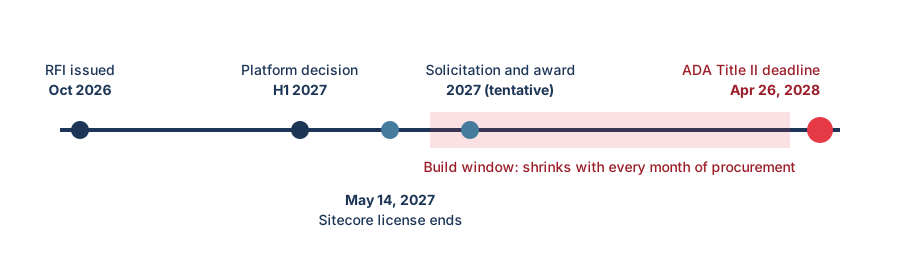
  • The deadline is fixed. The Air District calls April 26, 2028 a hard deadline. Procurement is still tentatively 2027.
  • Translation starts over. Existing translations in Spanish, Chinese, Vietnamese and Filipino won't migrate, and more languages are coming.
  • Headless isn't mandatory. A hybrid CMS may be proposed, and in-context editing isn't a requirement.
  • Open source is explicitly welcome. The Air District says a commercially supported open-source CMS "such as Drupal" may be proposed.
  • Nobody's numbers will match. No budget, spend, traffic, inventory or language planning figure was shared, so every five-year estimate rests on different assumptions. Our one request: publish a common assumption set with the RFP.
Timeline: RFI issued October 2026; platform decision first half of 2027; Sitecore license ends May 14, 2027; solicitation tentatively 2027; ADA Title II deadline April 26, 2028. The build window shrinks with every month of procurement.

Stop renting your website

  1. Drupal, hybrid. Content through APIs to any front end, plus Drupal-rendered pages where editors need preview and layout control. Choose per property.
  2. Own everything. No license fees, and code, content and configuration in agency-owned repositories and accounts. You can replace a vendor without replacing the platform.
  3. AI the agency controls, in three layers:
    • Inside AI: AI running in Drupal through the AI module, with a model provider the agency chooses. Editorial assistants, automatic tagging and alt text, classification rules such as comment moderation, suggested accessibility fixes and more, each turned on per role, logged, and passing the same human review gate as any other edit.
    • A context control center: the AI Context module keeps many small, governed snippets of context (voice, brand standards, glossary, current facts) that every AI feature draws on. Consistent context means fewer errors and output that sounds like the agency.
    • Outside AI: external assistants and agents that work with the site through Drupal's MCP server and Tool API, limited to specific authenticated actions, drafts only. This page was built that way.
  4. Triage the PDFs before remediating them, and gate every new document.
  5. Launch in phases driven by the deadline: the main site and emergency-information paths first.
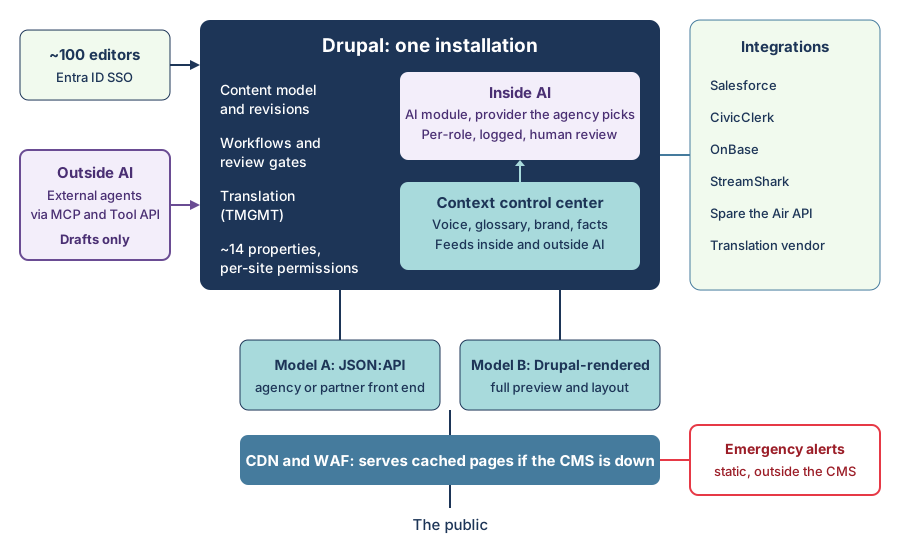
Architecture: about 100 editors (Entra ID sign-in) and outside AI agents (via MCP and Tool API, drafts only) connect to one Drupal installation. Inside it: content model and revisions, workflows and review gates, translation, per-site permissions for about 14 properties, inside AI through the AI module with an agency-chosen provider, and a context control center that feeds both inside and outside AI. Drupal connects to Salesforce, CivicClerk, OnBase, StreamShark, the Spare the Air API and a translation vendor, and delivers pages through JSON:API or Drupal rendering behind a CDN that serves cached pages if the CMS is down. Emergency alerts use a separate static endpoint.

The full response, item by item

These answers follow the RFI's numbering: Section III letters, with Section V item numbers in parentheses. Pick a tab, then open any item.

Profile & platform
A.A–A.B (3.1.1–3.1.2) Company overview and public-sector experience
A.A (3.1.1) Company overview

Freelock is a Washington-based open source web operations firm: a small but mighty team of seven. Its founder, John Locke, has built websites since 1996 and formed Freelock LLC in 2003. We're an implementer: we build, migrate, secure, host and maintain Drupal sites. With open source there's no separate platform vendor to buy from. We've worked with hundreds of customers, maintain more than 30 modules on Drupal.org, and have been credited on more than 200 Drupal.org issues. All staff work in Pacific Time.

A.B (3.1.2) Public-sector experience
  • City of Federal Way, federalwaywa.gov (Freelock prime). Drupal 7 to 10 migration in 2024, with departments organized as groups, per-department delegated editing and department landing pages. Ongoing support and a Drupal 11 upgrade are in progress.
  • WACares Fund, wacaresfund.wa.gov (Washington DSHS). Supported since 2024, with the contract extended twice. Work includes a benefits calculator, accessibility, extensive multilingual work, upgrades from Drupal 9 to 10 to 11, and a theme migration to Drupal Canvas.
  • Makah Tribe. Drupal 7 to 11 migration of a tribal government portal, with Group-based departmental editing.

We've worked with California nonprofits in the past, though we have no current California customers.

B.A–B.C (3.2.1–3.2.3) Platform, hosting, licensing and language costs
B.A (3.2.1) Platforms and hosting models

We implement Drupal 11. It runs anywhere PHP and a database run, so all three hosting models apply:

  • Agency-hosted in the Air District's existing Azure tenancy.
  • A managed Drupal platform host that holds its own security attestations.
  • Freelock-managed hosting, for smaller properties.

Moving between hosting models later is a server migration, not a platform migration.

B.B (3.2.2) Licensing and cost growth

Drupal is GPL-licensed. There is no license fee at any scale: no per-site, per-user, per-language or usage tiers. Over time, cost grows with development and support hours, hosting capacity, and third-party services such as translation, email and search hosting. All of those are visible, scoped and rebiddable.

B.C (3.2.3) Cost scaling with languages

The platform cost per language is zero. Enabling a language is a small configuration task. The real per-language cost is translation and human review, priced by the translation provider the Air District chooses. We don't use per-language pricing. Our work is priced by time, either as a project or a retainer.

B.D (3.2.4) Support, maintenance, hours and emergency coverage

Included in standard support: security and platform updates for core and contributed modules, uptime monitoring, backups, and a monthly budget of development hours for custom code and major upgrades.

Contracted separately: new features beyond that budget, translation services and document remediation.

Hours: support during Pacific Time business hours, with best-effort response after hours. Expanded or guaranteed after-hours coverage is available at extra cost, sized to what the Air District needs.

B.E (3.2.5) Separating content from presentation, and who owns what

Drupal is a hybrid. It delivers content through JSON:API (in core) or GraphQL (contributed), and it can also render pages itself. It works with any front-end framework, such as Next.js, Astro or plain server-rendered templates.

Responsibilities under each front-end modelResponsibilityModel A: agency or partner builds the front endModel B: we build it (Drupal-rendered where possible)Content model and API contractsUsUsDesign system and componentsFront-end builderUs (with a design partner)PreviewShared integration workUs (native)In-context editing and page compositionFront-end builder (limited)Us (native)Deployment pipelineEach party for its own layerUsWCAG 2.2 AA conformance of published pagesFront-end builderUsAuthoring-interface accessibilityUsUsDefect resolutionEach party for its own layerUs

Our recommendation is Model B, with decoupled components only where they earn their keep, such as live air quality displays.

Migration & portfolio
C.A (3.3.1) Re-platform, replace, or retire customizations

We inventory each customization by what it does for a visitor or editor, not by how it was built. Then we sort it into one of three buckets:

  • Replace with native Drupal features or configuration.
  • Rebuild what serves a real ongoing need.
  • Retire workarounds for old platform limits.

Three rendering approaches (classic Sitecore, SXA and JSS) and two forms systems suggest a lot can be retired.

C.B (3.3.2) What drives effort and duration

The main drivers:

  • Content decisions: what stays, merges or goes, and how fast division owners make those calls.
  • The document backlog.
  • Integrations with undocumented APIs.

What reduces them:

  • Disposition rules agreed early.
  • A tracking list showing every source URL's fate.
  • Scripted migration for structured content.
  • Deadlines for owners.
C.C (3.3.3) Automated versus editorial migration, and quality review

Drupal's Migrate API imports structured content from the Sitecore exports and content database copy the Air District plans to provide. Restructured content is rewritten by people into new templates. Quality review runs by division against the tracking list.

If an export is missing or incomplete, we fall back to the public site itself (crawled HTML and media), or rebuild that content by hand where it's small. We'd ask for a non-production copy of the content database as a planning assumption.

D.A (3.4.1) Managing a portfolio of sites

We'd use one installation and one database, serving all properties through the Group or Domain modules. That gives shared components, media and editors, plus per-site permissions and theming. Spare the Air keeps its own brand as a per-site theme on shared components. Freelock maintains modules in this space and ran a Domain and Group "sitelets" portfolio for Skillmation for eight years.

Cost grows with distinct designs and integrations, not with domain count. Separate-database multisite remains an option for any property that needs isolation.

Authoring & translation
E.A–E.B (3.5.1–3.5.2) Editors, permissions and approval workflows
E.A (3.5.1) Occasional and expert editors

Occasional editors get structured forms with constrained choices and in-editor guidance. Expert editors get page composition in Drupal Canvas. Both use the same accessible admin interface. Federal Way runs this split today.

E.B (3.5.2) Permissions and approval workflows

Content Moderation (core) provides draft, review and publish states, with different workflows per content type. Group-based access restricts editors to sections, and field-level and component-level restrictions are configurable. Home and major landing pages stay with the web team.

Limited, time-boxed access for outside contractors is a role, not custom code. The same goes for AI agents.

E.C–E.E (3.5.3–3.5.5) Versioning, public-records history and recurring publishing
E.C (3.5.3) Versioning, scheduled publishing and rollback

Every save is a revision, with side-by-side comparison and one-click revert. Scheduled publishing and unpublishing are configuration.

E.D (3.5.4) Content history for public-records requests

Revisions record the author, the time and the full content, including documents and translations. History can be searched and exported in open formats (CSV or JSON). Deleted content isn't lost either: the Trash module captures everything that's deleted and keeps it for a set retention period before it's purged, so retention can follow Resolution 2023-11.

E.E (3.5.5) Recurring structured publishing, such as board agendas

A board meeting becomes a content type that links the CivicClerk agenda, related documents, the StreamShark video and the minutes. Recurring publishing can be automated with Drupal's ECA module, to which our founder contributes. The website organizes the public record without duplicating it.

F.A–F.B (3.6.1–3.6.2) Multilingual capabilities and translation vendors
F.A (3.6.1) Native multilingual capabilities

Drupal's multilingual tools are industry-leading, and they're in core: field-by-field content translation, translated interface and configuration, per-language URL prefixes, and hreflang links on translated pages. Translated pages appear in per-language sitemaps. Where a page hasn't been translated yet, visitors see the original language rather than an error.

Complex landing pages used to be the weak spot. Recent Drupal Canvas releases fixed the issues we'd hit with ongoing translation of component-heavy pages.

F.B (3.6.2) Translation services and vendor choice

The Translation Management Tool (TMGMT) connects to human translation vendors, translation management systems and machine translation engines through provider plugins, or through XLIFF files for any vendor. The Air District picks the vendor and can change it.

F.C (3.6.3) AI-assisted translation with human review
  1. Extraction: TMGMT pulls translatable fields from every component on a page and writes the results back to the same fields. Documents in the media library are translated as per-language files.
  2. Engine: the Air District chooses the machine translation engine. Processing location and retention depend on that engine, and we'd require contractual no-retention and no-training terms.
  3. Context: the agency's glossary and voice guidance are supplied to AI translation as governed context, so terms come out the same way every time.
  4. Review gate: machine-translated content enters a moderation state that only a designated reviewer role can publish. The gate can be applied per content type or section, and approvals are recorded in revision history.
  5. Source changes: changed source content flags its translations as outdated and can queue them automatically.
  6. Vendor exit: translations are stored in Drupal as content, so they stay published and editable. Translation memory and glossaries export as TMX and TBX.
Accessibility & integrations
G.A–G.C (3.7.1–3.7.3) Accessibility at render and authoring time, ACR, and a document gate
G.A (3.7.1) WCAG 2.2 AA at render time and authoring time

Accessibility review is part of how Drupal core accepts changes, for both the public site and the admin interface. On top of that we add Editoria11y, an in-editor checker that flags problems while editors work, so they're fixed before publishing. It's running on our own site (see the screenshot above). AI can suggest fixes, which go through review like any other edit. Siteimprove continues scanning the live site.

Our testing combines automated scans (our own tooling, built by our accessibility lead), manual keyboard and screen-reader testing, and retesting after every fix. See our accessibility statement.

G.B (3.7.2) Accessibility Conformance Report

We'd deliver an ACR for the theme and front end we build, and attach the hosting provider's documentation.

G.C (3.7.3) A remediation gate for documents

Documents are media items with a required accessibility review state. A document can't be published until a reviewer marks it conformant, enforced by the same moderation workflow as pages. For the backlog, triage comes first (see the PDF section below). Bulk PDF remediation, including AI-assisted remediation, is specialist work we'd recommend procuring separately, priced per document after triage.

H.A–H.B (3.8.1–3.8.2) Integration architecture and specific systems
H.A (3.8.1) Integration architecture

Integrations use APIs and webhooks, built as small, separately maintained modules on Drupal's plugin system. Drupal's stable APIs and semantic versioning mean integrations survive upgrades. We've carried client sites through many major upgrades, from Drupal 8 to 11, in place.

H.B (3.8.2) CRM, agenda, document management and service desk

Our assumed launch approach for each system:

  • Salesforce: form submissions and data sync via its API. We've completed multiple Salesforce integrations and currently manage sites that depend on them.
  • CivicClerk: link or embed, with an API integration later.
  • StreamShark: embed.
  • OnBase: link.

We haven't worked with CivicClerk, StreamShark or OnBase before, but we've done a great deal of API integration work on both the client and server side. These are assumptions pending the inventory.

H.C–H.D (3.8.3–3.8.4) Real-time air quality data and forms
H.C (3.8.3) Real-time air quality data

Data is fetched server-side and cached. Every display shows the data's timestamp and switches to a visible stale-data label past a set threshold. If the source fails, visitors see the last known good data, clearly marked.

H.D (3.8.4) Forms

The Webform module provides accessible forms. Submissions are stored in Drupal, encrypted where needed, or forwarded to Salesforce, with retention rules per form.

I.A–I.C (3.9.1–3.9.3) Media library, site search and email
I.A (3.9.1) Media and document library

The core media library handles organizing, versioning, superseding and retiring documents, plus the accessibility gate above. A separate DAM product isn't needed at this scale.

I.B (3.9.2) Site search

Search API, backed by Solr or OpenSearch, indexes pages, the text of PDFs and structured data across all sites and languages, with tunable relevance. We'd propose acceptance tests built from the top search terms.

I.C (3.9.3) Email, newsletters and operational notices

We recommend a dedicated email and subscription service integrated with the site, because deliverability is its own discipline. Operational notices to staff, such as send-completion confirmations, are handled by ECA rules that post to email or the agency's chat tool.

Security & AI
J.A–J.B (3.10.1–3.10.2) Single sign-on and security posture
J.A (3.10.1) Single sign-on with Entra ID

OpenID Connect or SAML modules connect to Entra ID, with Entra groups mapped to Drupal roles at each login. Removing someone from a group removes their access.

J.B (3.10.2) Security posture, patching, testing and monitoring
  • Attestations: Freelock does not hold SOC 2, FedRAMP or other formal certifications. Attestations would come from the hosting provider, and we describe our own controls separately.
  • Payment card compliance: we've completed PCI DSS SAQ-D in the past. Our current environment only requires SAQ-A.
  • Experience: we've done a lot of post-attack remediation and cleanup, hardening and security auditing, and we run strong prevention policies.
  • Software bill of materials: we're building SBOM tooling across our entire infrastructure, and can provide SBOMs for both hosting and the CMS.
  • Patching: the Drupal Security Team publishes advisories on a fixed weekly schedule. Our Drupal Protection Plan applies core and contributed updates as they're released.
  • Testing: load testing before launch and after major changes.
  • Monitoring: visible to agency staff through a status page and alerts routed to the agency's chat tool.
J.C (3.10.3) Backups, disaster recovery and emergency publishing
  • Two independent backups, every night: typically a snapshot at the host, plus a file-based backup, end-to-end encrypted with Kopia, sent to a different provider's object storage.
  • History: specific historical snapshots are kept for up to a year.
  • Recovery: we can typically recover a site within one business day.
  • Staying up: the CDN keeps serving cached pages if Drupal is down.
  • Emergency publishing: alerts use a separate static endpoint that staff can update without the CMS.
  • Escalation: long outages follow a documented path naming who the Air District calls first.
J.D–J.H (3.10.4–3.10.8) Encryption, account protection, deletion, logging, WAF
  • Encryption: TLS 1.2 and 1.3 in transit, encryption at rest from the host, and secrets in a vault.
  • Accounts: MFA enforced by Entra ID. Local logins are disabled except documented break-glass accounts, and privileged production access is limited and logged.
  • Deletion and exit: content and personal data can be deleted on request. At contract end, the Air District already holds its code, database and files in open formats.
  • Logging: logins, permission changes and content changes are logged and exportable to syslog. Logging is included, with no premium tier.
  • WAF and bot protection: provided at the CDN, administered by the host or the agency, and layered with the agency's own edge protections.
K (3.11) AI capabilities

Drupal's AI capabilities are extensive, and they cover AI inside the CMS, AI outside it, and the context both depend on.

Inside AI

The AI module runs AI within Drupal, with pluggable provider modules, so the agency chooses, restricts or swaps the model provider. Capabilities include editorial assistants, automation rules that call AI for classification (such as comment moderation), automatic tagging, alt text and image generation, automated workflows, suggested accessibility fixes, and much more.

Outside AI

An MCP server and Tool API let external assistants and agents take specific, authenticated actions on the site, and nothing beyond them. This page was built that way, with drafts only.

Shared context

The AI Context module provides a context control center: many small snippets covering brand, voice, glossary, current statistics or anything else, supplied consistently to both inside and outside AI. That reduces errors and hallucinations and keeps output in the agency's voice.

Control and accountability
  1. Licensing: the AI framework is open source with no license fee. Only the chosen provider's usage costs apply.
  2. Enablement: features are turned on per feature, per site and per role. Nothing is on by default.
  3. Data: only content the editor sends is shared, and retention and training terms come from the chosen provider's contract.
  4. Review and audit: AI-generated changes are flagged, pass the same moderation gate as everything else, and appear in revision history, with auditing and reporting on AI use.
  5. Security: AI features are covered by the same authentication, permissions and logging.

Our own delivery use of AI is governed by our published AI Use Policy, and so is this page.

Implementation & cost
L.A–L.D (3.12.1–3.12.4) Team, training, architecture and procurement structure
L.A–L.C (3.12.1–3.12.3) Team, training and architecture

Team: a technical lead, Drupal developers, an accessibility lead and a project manager, plus content strategy and design partners. The Air District works directly with every technical lead.

The Air District provides: a product owner, a content lead per division, timely decisions and exports.

Training: role-based training for occasional editors, expert editors and reviewers, with recorded sessions and written guides, then office hours as publishing shifts to divisions.

Architecture: see the diagram above. Key risks are content-decision speed, the document backlog and undocumented integration APIs.

L.D (3.12.4) One prime or split procurements?

With open source, the "platform vendor" category mostly disappears; there's no license to buy. We'd recommend:

  • One contract for implementation and ongoing operations, with all work in agency-owned repositories, so a rebid can replace the firm without replacing the platform.
  • Separate, volume-priced procurements for bulk PDF remediation and translation services.
  • Content strategy and user research as either a named subcontractor or a separate award.
L.E–L.F (3.12.5–3.12.6) Timeline and migration models
L.E (3.12.5) Timeline by phase
  • Discovery and information architecture: 2–3 months
  • Build: 4–6 months, overlapping with migration
  • Phase 1 launch: baaqmd.gov core and emergency paths
  • Phase 2: Spare the Air properties
  • Phase 3: remaining program sites
  • Stabilization: 2 months after each launch

If the contract isn't signed by mid-2027, Phase 1 is the realistic target before the accessibility deadline.

L.F (3.12.6) Migration models from 90% vendor to 90% Air District
  • About 90% vendor: we rebuild retained pages and divisions approve them. Fastest, highest vendor cost.
  • Shared (recommended): scripted migration of structured content, with us building landing pages and divisions rewriting their pages after training. This assumes each division can give one or two authors a few hours a week during migration.
  • About 90% Air District: we build the platform, tooling and templates, then train and coach. Lowest vendor cost, highest staff time.
L.G–L.H (3.12.7–3.12.8) Support models and a small enhancement
L.G (3.12.7) Support models

We don't offer security-only support, because updates without someone accountable for what they touch aren't really support. Our Drupal Protection Plan covers all core and contributed module updates within a major release, combined with an hourly budget for custom code updates and major-version upgrades. It works on Freelock-managed hosting or on agency or partner hosting.

Typical annual spend for agency sites:

  • Minimal support: around $15,000 a year.
  • Active use with ongoing improvements: $30,000–$50,000 a year.
  • Actively expanding on a roadmap: $70,000–$300,000 a year.
L.H (3.12.8) A small enhancement

Adding a status field and showing it in a listing is configuration, deployed through version control and tested. It's a few hours of work under any of these models.

M–N (3.13–3.14) Cost estimate, references and demonstration
M (3.13) Cost structure and five-year estimate

One planning scenario: Model B front end, shared migration, about 14 properties launched in three phases.

Nonbinding planning estimateItemTypeEstimatePlatform licenseAnnual$0Discovery, information architecture and content strategyOne-time$25,000Platform build: content model, workflows, SSO, multisite, search, integrationsOne-time$55,000Front end, Model B (Drupal-rendered)One-time$45,000Migration, shared modelOne-time$40,000Accessibility testing and launchOne-time$15,000TrainingOne-time$10,000Total implementationOne-time$190,000HostingAnnual$6,000–$18,000, by hosting modelDrupal Protection Plan and enhancementsAnnual$30,000–$50,000Translation, PDF remediation, CDN/WAF, email, AI usageThird-partyUsage-priced; shown separately

Alternatives: Model A replaces the $45,000 front end with about $20,000 of API and preview integration, plus whatever the agency's front-end builder charges. Vendor-led migration is about $75,000; agency-led about $20,000.

Five-year picture: $190,000 implementation, plus roughly $36,000–$68,000 a year for hosting and support, comes to about $340,000–$460,000 over five years before third-party services.

Assumptions:

  • Rate: $180/hour, so implementation is roughly 1,050 hours.
  • Five years begin at contract signing, with about four years of operations after launch.
  • About 14 properties, phased.
  • Roughly 60% of about 1,360 pages retained.
  • Four languages at launch (English, Spanish, Chinese, Vietnamese), with Filipino and others added later.

Excluded: bulk PDF remediation, translation fees and Air District staff time.

N (3.14) References and demonstrations

References are available on request if the Air District moves forward. Demonstration: this page, and how it was built.

Your PDFs are the real accessibility problem

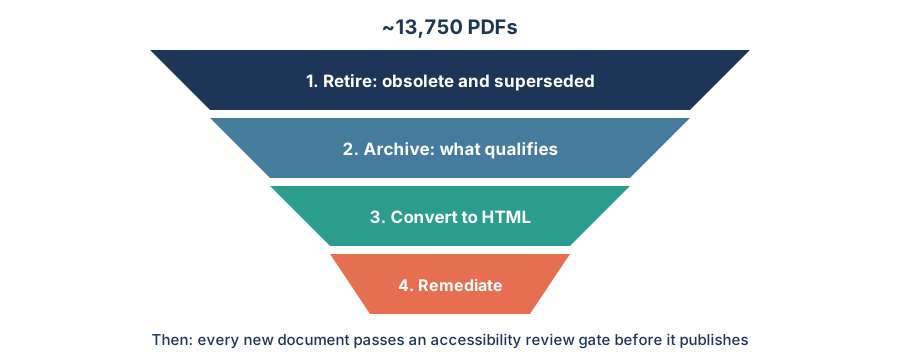
No CMS makes a backlog of inaccessible documents conformant. The workable approach is triage, so remediation money goes only where it's needed.

The Title II rule helps, within limits. Two of its exceptions matter most here:

  • Archived web content is exempt only if it was created before the compliance date (or reproduces paper records), is kept only for reference, research or recordkeeping, isn't changed after archiving, and sits in an area clearly marked as an archive.
  • Preexisting documents (PDFs, word processing, presentation and spreadsheet files) posted before the compliance date are exempt, unless they're currently used to apply for, access or take part in the agency's programs or services.

So the triage questions are: Is anyone still using it? Is it part of a service? Can it live in a real archive? Anyone who needs an exempt document in an accessible form can still request one.

HTML conversion has a bonus: those documents become searchable and translatable too. And no CMS shortens a procurement calendar. Phasing is the tool for that.

This is our reading of the rule, not legal advice. Confirm with counsel before relying on an exception.

Funnel: about 13,750 PDFs. 1. Retire obsolete and superseded documents. 2. Archive what qualifies. 3. Convert documents people use to accessible HTML. 4. Remediate only what must remain a PDF. Then every new document passes an accessibility review gate before it publishes.

How we built this page (and what broke)

This page has more than 110 components: a hero, stat blocks, grids, cards, diagrams, six tabs and two dozen accordions, each with its own settings. Drupal Canvas makes a layout like that straightforward. AI makes it easy.

Claude, Anthropic's AI assistant (the Opus 5.5 model), built it through Drupal's Tool API and MCP. It chose components from our theme's library, nested them, set their options, uploaded images and wrote the alt text. We reviewed each pass in the Canvas editor and sent back notes, the way you would with a designer.

What the AI could do

  • Draft blog posts and Canvas pages
  • Add, move and configure components
  • Upload images and documents to the media library
  • Stage structured data for search engines

What it couldn't do

  • Publish anything
  • Delete code, change site settings, or touch user accounts or templates
  • Use a tool we hadn't turned on. When it needed one, it said so, and we decided whether to add it.

Those limits come from Drupal's permission system, not from a polite request in a prompt.

What went wrong, and how review caught it

  • The statistic component strips everything except digits. "100 authors on 10 seats" showed up as 10,010, and April 26, 2028 became 4,262,028. We caught it in preview and rewrote the stats.
  • Two diagrams landed in each other's sections after a mix-up over media IDs. One note fixed it.
  • The first version had a gap under the hero, and the stats ran off the right edge of the screen. One round of feedback fixed both.
  • The hero photo credit ran off the edge on phones. Another round of feedback.

None of that reached the public, because nothing reaches the public until a person approves it. That's the whole idea.

The bigger point

Read the Air District's requirements together: own the code, choose the translation vendor, choose the AI provider, let every editor work, hand the site to another contractor someday. That's a description of freedom from lock-in. That's what open source is, and it's why Drupal fits this problem better than its reputation suggests.

Facing a license renewal and an accessibility deadline of your own? Talk to us about an assessment. We'll tell you what we'd keep, what we'd retire, and what it would really cost.