
[Update: a few days after I published this, Vector.im rebranded as Riot.im. It's the same project, just a new name...]
In 5,000 years, will anybody be able to read (or even access) things we put online today? Here at the dawn of the information age, we are creating the archetypes that have big implications, possibly for thousands of years. There's a bunch of recent science fiction stories that imagine various futures, written with the perspective of today's web, extrapolating where things might go as humanity evolves.


As somebody working in the field, I got the sense that Stephenson nailed the tech. The programs that were invented to manage the "swarm" of satellites in orbit involved each craft having its own central computer coordinating with its neighbors, with the ability to disconnect and reconnect, fascinating stuff.
Since Seveneves was published, I've run across two new open source projects that would be instrumental in providing a "disconnected" Internet that could function well in space. One has already become a pretty major backbone of our business today: Matrix.org. The other has the honor of the greatest name -- the InterPlanetary File System, or IPFS for short.
Matrix - Permanent, secure, reliable, distributed messaging
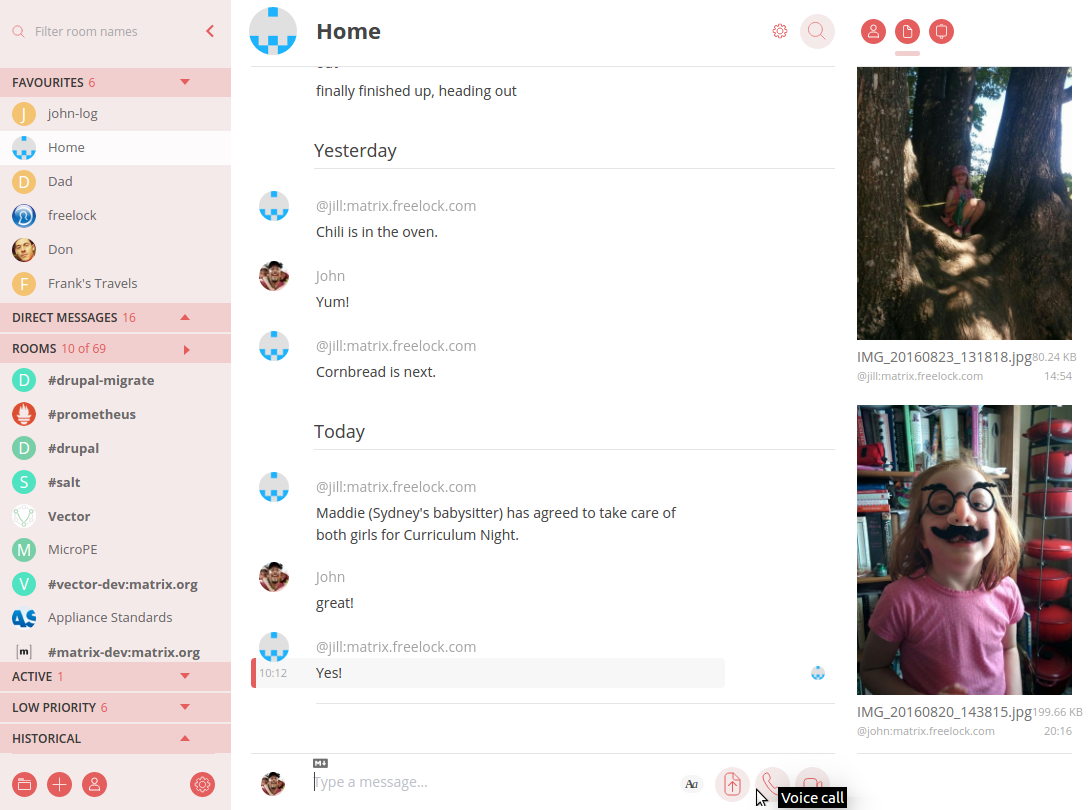 For the past couple years, the corporate world has been bombarded with Slack, a new-ish messaging platform that organizes conversations into "teams" or rooms. Matrix looks from the outside to be very similar to Slack -- but it has some big differences under the hood. The biggest difference is that Slack is a closed silo, a hosted service controlled entirely by a single company, whereas Matrix aims to be a fully open, interoperable system where most organizations will run their own server, and talk with each other via "federation" -- very much the way email works.
At Freelock, we have a Matrix room on our own server for each client project. We have a bot that kicks off tests, deployments, retrieves login links for us, assembles release notes, and even keeps track of our time. We also interact with the wider Internet through it, as it bridges over to other chat networks (mainly IRC), and more and more open source projects we depend upon have moved their team communications over to Matrix.
Matrix is about to roll out End-to-End encryption to protect the privacy of your messages from everyone other than the person or group you're conversing with. For more public conversations, the full history of a room is stored automatically, permanently, until everybody manually purges history off all the servers involved in the room. This makes room searches very effective, allows for permanent links to points in the conversation, and means you can keep up with the conversation as you move to different devices.
This just barely scratches the surface of why we think Matrix is great, and it's already becoming a regular topic on our blog.
The best way to check it out is using the Vector.im Riot.im client, where you can create a free account on the matrix.org server. There are also very nice Vector Riot clients for IOS and Android.
IPFS - Never follow a dead link again!
Imagine if you were on a spacecraft, disconnected from Earth, and you wanted to watch a YouTube video, but couldn't reach YouTube. More immediately, what if you need the instruction manual for a particular appliance you just purchased, but the company who made it went out of business and their website is gone?
In today's web, you find content at a particular location. If that location goes away, or you can't reach it for one reason or another, the content is gone -- you have no way of accessing it. IPFS re-imagines the whole architecture of the Internet. Instead of asking for the content at a particular location (e.g. the URL, using http), you ask for a particular piece of content, and IPFS goes out and finds it for you. It might be at your neighbors, or it might be around the world -- but as long as somebody you can reach on IPFS has it, you can get a copy from them.
As best I can tell, this is the current leading edge of Peer-to-Peer networks, with truly lofty goals. They are currently targeting the developing world, disaster zones, archivists, and researchers among others, promising to deliver far better performance, dramatically reduce bandwidth costs, and increase resiliance and permanence of things you want to store.
IPFS isn't quite ready for non-technical users -- I'm not even using it yet. But the concept is very intriguing, and if you think about the role of your content beyond the immediate next few months, this is something to keep an eye on.
Is your website permanent, or disposable?
We're seeing a few customers that think of their website as a disposable, one-off marketing brochure. When looking at upgrades to keep their site safe and secure, they question why they should spend so much on an upgrade, when they can build an entirely new website for less -- sometimes substantially less -- cost.
Sometimes it does make sense to start over. But twenty years into this experiment that is the World Wide Web, there's a lot of useful stuff already online. If your site has useful content, it might be one of your biggest assets. Search Engines reward sites with lots of content -- while you may want to go purge a lot of older stuff, it is probably helping you stay relevant on searches, especially if you regularly add new content.
If you wipe your site clean and start over, you're losing history, context, depth, and probably search rankings. When you browse websites, does a slick glossy single-page site feel authentic? Does it draw you into any kind of relationship? Is there rich content, evidence of stability, historical clients, products, services, knowledge available?
There are certainly times to do a good housecleaning, but we think wholesale website replacements that don't bring your content over are greatly reducing the actual value of your website. It certainly costs more to curate your content and clean it up than it does to start over -- but that's because it's worth more, and the more you have, the more valuable an asset it can be.
Drupal and the Permanent Web
... You knew we had to get to Drupal somehow in here, didn't you? We've launched our first few sites on Drupal 8 this summer, and we are very impressed with the platform. It has an entirely new core, fully modernized to last for at least the next decade or two, if not the next millenium. It has a nicely upgraded user experience, while preserving many of the same basic concepts Drupal has had for the last decade. It's very easy to integrate with other systems -- we just started a new internal Drupal 8 site that's fast becoming the hub for integrating our various other systems, along with Matrix.
But the biggest win with Drupal 8 in this area is migration. We're finding that an upgrade to Drupal 8 can save thousands of dollars compared to an upgrade to Drupal 7 -- and it's relatively easy to migrate from WordPress, Joomla, and many other systems. An upgrade to Drupal 8 from Drupal 5 or Drupal 6 is a matter of a few hours. We do end up having to build out the actual look and feel on the upgraded site -- but most people upgrading from that era need a new theme to support mobile devices in any case.
For keeping old content fresh, we routinely provide some very easy-to-use workflow that keeps track of the pages you've edited already, so you can implement a regular review to keep stuff fresh. And it's easy to add entire fields to old content, if you decide that you want to add an "in the field" photo to an outdoor product for example, or solicit customer ratings.
Drupal is a content management powerhouse. If you need to manage a lot of content, or things like project plans, customer records, commerce data, a completed graphical project portfolio, subscriber lists, or any number of other kinds of information, you won't find a better platform for doing so.












Add new comment